
Rezzy Doesn't Write Your Resume. It Makes You Write Better.
Most AI resume tools work like this: paste your resume, click "improve," get back corporate mush. "Leveraged cross-functional synergies to architect scalable solutions." Cool. Nobody talks like that. Nobody should. We built something different.
The Problem With "Improve My Resume"
Most AI resume tools take your bullets and smooth them out into something that sounds polished but says nothing. You end up with a resume that could belong to anyone. We built something different.
Here's what typically happens when you paste your resume into ChatGPT and ask it to make your bullets better: it takes "Helped customers with returns" and turns it into "Facilitated seamless customer experience optimization through proactive return management initiatives." The original told me what you did. The "improved" version just tells me you know how to use a thesaurus. Hiring managers see through this immediately, and while AI detectors are easy to game, you shouldn't have to game them. If your resume sounds like it was written by a bot, something went wrong.
The real problem isn't that your bullets need polish. It's that they're missing specifics. What tools did you use? What actually changed? What was the outcome? This is true whether you're using AI or not. It's just hard to remember what you did, why it mattered, and how to say it clearly. Those details are sitting in your head, not on your resume. And no amount of AI polish will invent them for you.
That's why we built Rezzy differently. Instead of polishing what you wrote, it helps you articulate what you actually did.
The Report Card: How We Actually Score Your Bullets
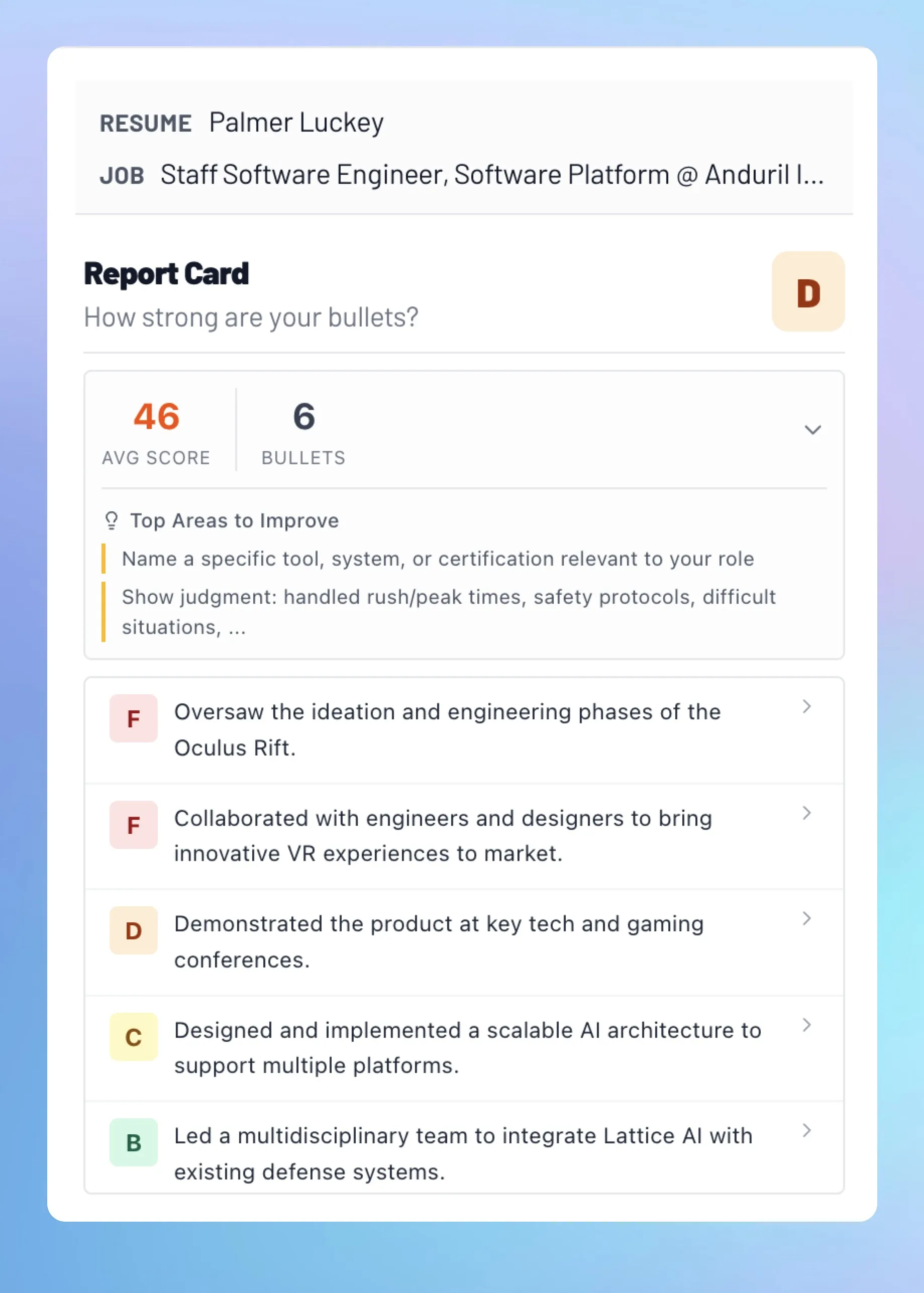
Ask Rezzy to "audit my resume" and you get a Report Card. Not vague encouragement. Actual grades. A through F for each bullet, with scores across five dimensions:
| Dimension | Weight | Question | Example |
|---|---|---|---|
| Tool Specificity | 20 pts | Did you name a real tool, system, or platform? | "Salesforce" scores. "CRM software" doesn't. |
| Task Clarity | 25 pts | What did you actually do? | "built," "debugged" score. "helped," "worked on" get flagged. |
| Measurable Outcome | 25 pts | Did something change? Numbers matter. | "Reduced wait time by 40%" scores. "Improved efficiency" doesn't. |
| Judgment Shown | 15 pts | Did you handle constraints or tradeoffs? | "Added fallback for peak hours" shows thinking. |
| Human Legibility | 15 pts | Would a stranger understand what you built? | No buzzword soup. No "leveraged synergies." |
The Report Card shows your average score, overall grade, and flags specific issues. If all your bullets are missing metrics, it tells you. If you're using weak verbs, it catches that pattern.
Context Gathering: We Ask Before We Rewrite
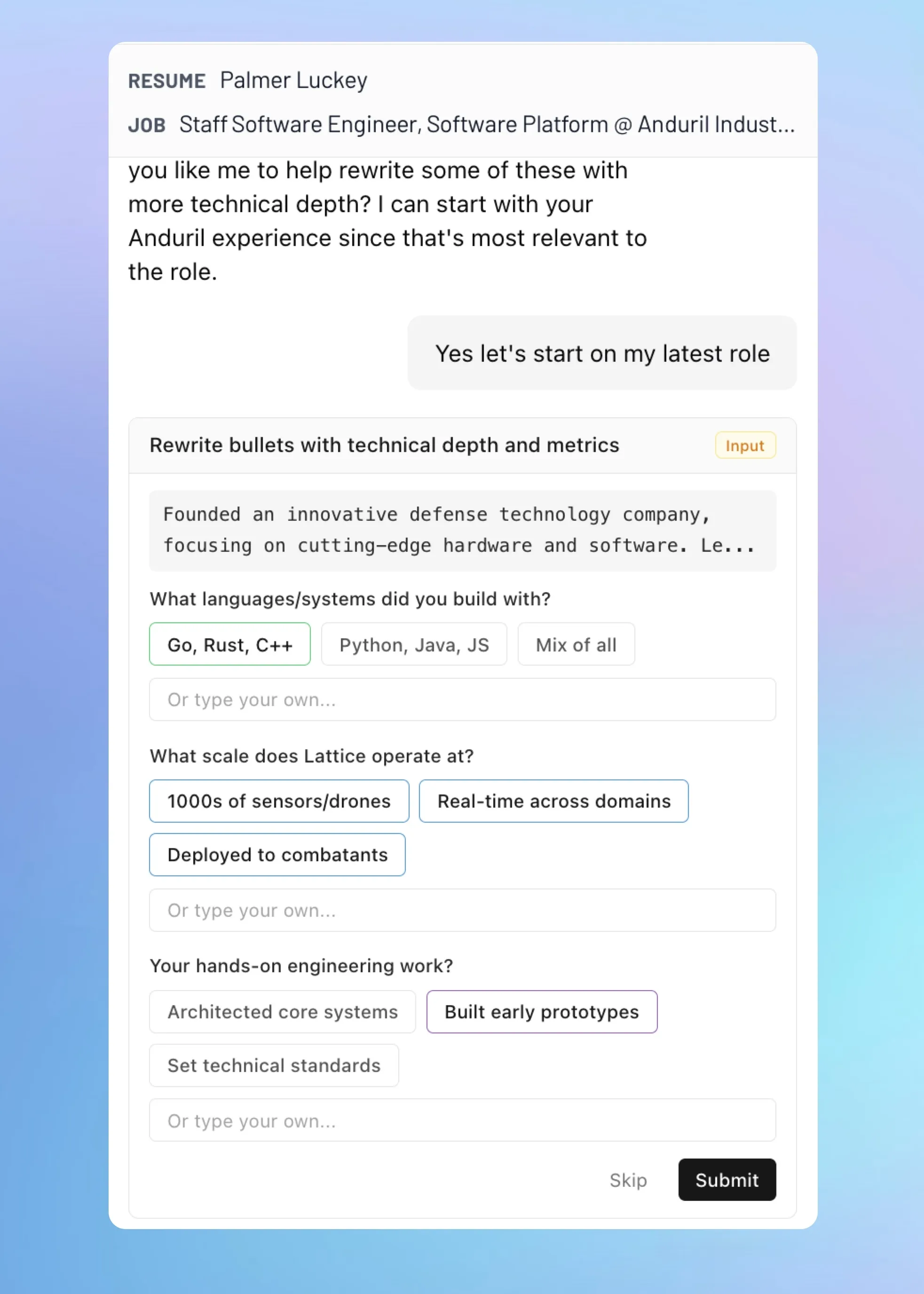
Say you have a bullet that scores poorly: "Built features for healthcare platform." That's vague. What kind of features? What was the impact? What tools did you use?
Most AI tools would guess at the details and fill in something plausible. Rezzy takes a different approach: it asks you.
When you ask to improve a weak bullet, a Context Gather card appears. Two or three quick questions with selectable options based on your context:
| Question | Options |
|---|---|
| What type of feature? | Claims processing, Eligibility verification, Provider tools |
| What was the impact? | Faster processing, Fewer errors, Cost savings |
Pick from the options, or if none of them fit, just type your own. The answers feed directly into the rewrite. The improved bullet reflects what you actually did, not what the AI imagined.
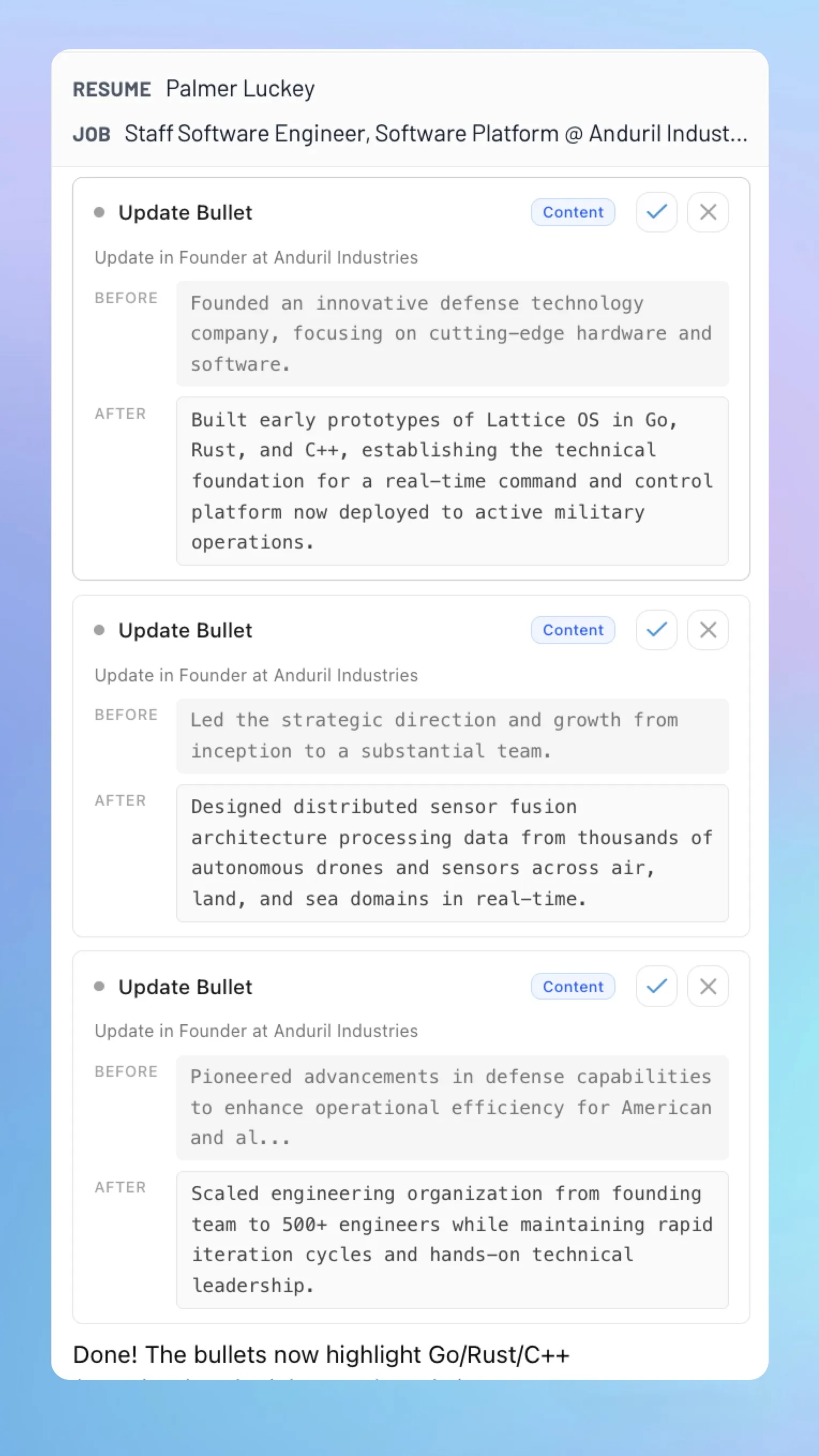
This is the core philosophy: the AI doesn't invent your experience. It helps you articulate it. The specifics come from you. The structure comes from us.
Form Input: Structured Data Collection
Sometimes Rezzy needs more than quick-select options. When you're adding experience dates, skills, or certifications, the Form Input card appears with proper fields:
Date ranges for job tenures. Tag inputs for skills (comma-separated, parsed automatically). Text fields for descriptions. Select dropdowns for categories.
This replaces the back-and-forth of "what are the dates for your Google role?" with a clean form you fill out once. The data goes straight into your resume.
Human-in-the-Loop: You Approve Everything
Every change Rezzy proposes shows up as a card. Add a bullet? You see the text first. Update a skill category? Preview before it commits. Remove an experience? Explicit confirmation required.
This isn't just about giving you control over the output. It's about maintaining authenticity.
AI detectors work by measuring how "predictable" your writing is. Smooth, uniform, evenly paced text gets flagged as machine-generated—even when a human wrote it. The more you let AI rewrite everything at once, the more your resume sounds like everyone else's.
When you're reviewing each change individually, deciding what fits your voice and what doesn't, you maintain authorship. The AI proposes; you decide. Your sentences vary because you're the one assembling them. The rhythm stays human because a human is doing the final editing.
What You Can Actually Ask For
Rezzy doesn't have an "improve my resume" button. It has specific tools for specific actions:
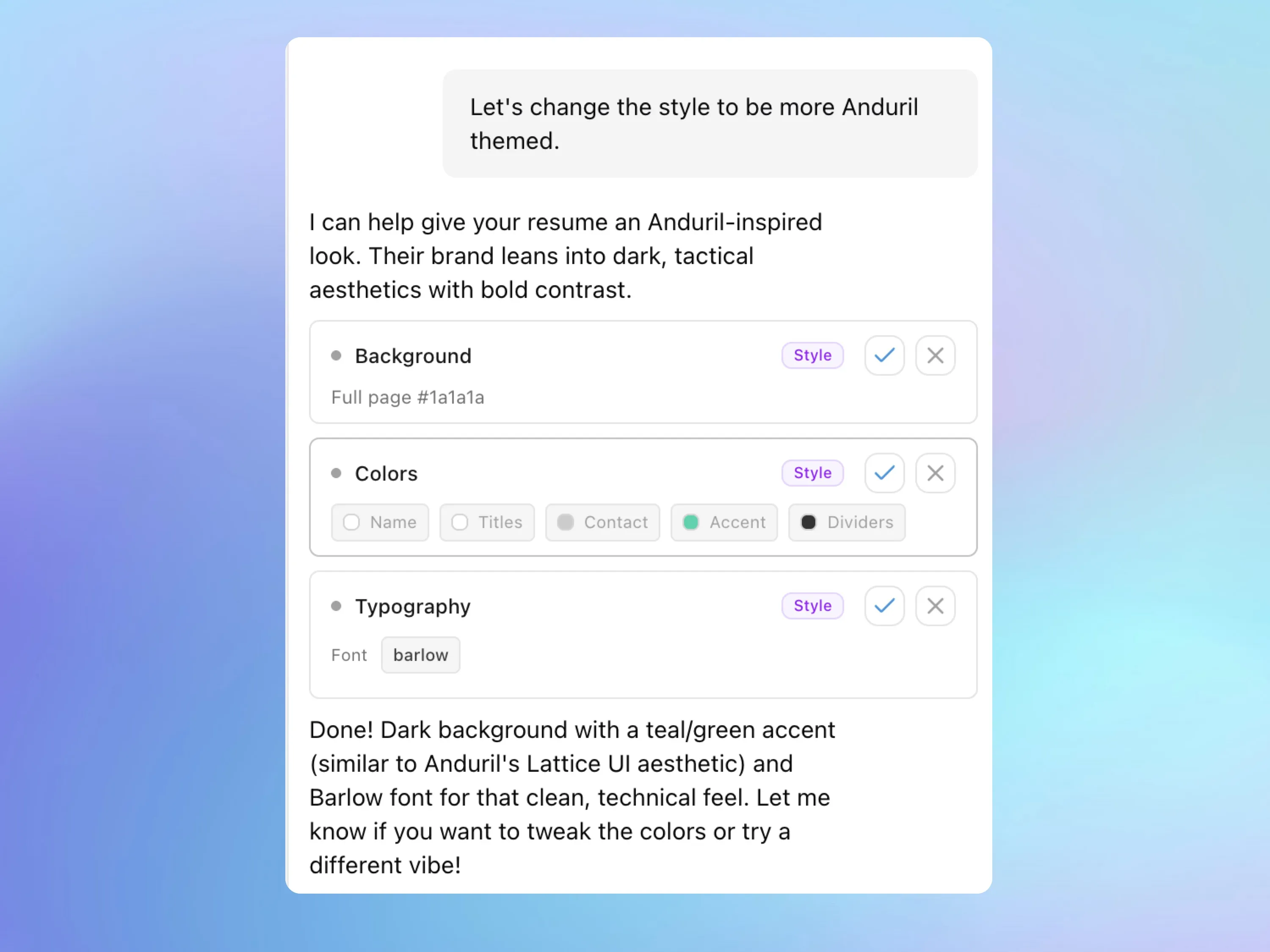
This specificity matters because you always know exactly what's happening. When you see Add Bullet in the chat, you know a bullet is being added. When you see Update Experience, you know which fields are changing. There are no black boxes and no wondering what the AI did to your resume while you weren't looking.
Works for Every Job, Not Just Tech
The audit engine scores verb strength regardless of industry. We built tactile verb lists for:
Same for outcome patterns. We detect metrics for table turns and guest counts, not just API latency. Safety records and on-time delivery, not just uptime percentages. Student test scores and patient satisfaction, not just NPS.
No Fabrication. Ever.
Rezzy can add education, certifications, and skills, but only what you tell it to add. It won't invent credentials. If you ask to add an AWS certification, you're the one providing that information. The AI structures it; you own the facts.
Skills it suggests must be grounded in your existing experience. If your bullets mention Python, it might suggest adding Python to your skills section. It won't suggest Rust because Rust sounds good.
This is the human-in-the-loop philosophy applied to content integrity. You provide the substance. The AI helps you present it clearly.
Try It
Ask Rezzy to audit your resume. See where your bullets are weak. Let it ask you the questions that surface the specifics. Watch your generic statements become concrete achievements.
At the end of the day, the AI doesn't write your resume for you. You write it. Rezzy just helps you write it better.
See What Rezzy Can Do
Audit your bullets. Get real grades. Surface the specifics that make your work legible.