
Why Your Resume Needs a Name Attached to It
You're about to spend 40+ hours a week somewhere. Shouldn't you know what you're getting into? Most people apply blind. Submit resume, hope for the best, learn nothing until the interview. That's backwards. We built something to fix it.
The Information Asymmetry Problem
Think about what companies know about you before an interview: your resume, your LinkedIn, your GitHub, maybe a cover letter, possibly some light social media stalking. They've got the full picture.
Now think about what you know about them: a job posting and a careers page. Maybe a Glassdoor review from 2019. That's it.
The interview is usually the first time you learn anything real about the team, the work, the culture. By then you've already invested hours preparing. What if it's not even a good fit? What if the team is a mess? What if the "fast-paced environment" means "we have no process"?
Research isn't desperation. It's due diligence. You're about to commit a significant chunk of your life to this place. You should know what you're walking into.
People Search: Know Who You'd Be Working With
Text2Resume now includes research tools powered by Exa AI. The first one: People Search. Ask who's on the team and get actual LinkedIn profiles back.
This isn't the same as searching LinkedIn directly. LinkedIn's search is optimized for job postings and recruiter workflows. Search for "engineering manager at Stripe" and you'll get job listings, not people.
Exa built something different. They've indexed over a billion people and trained a semantic retrieval system specifically for finding humans. Their people search benchmark evaluates three types of queries: role-based lookups ("VP of product at Figma"), skill-based discovery ("director of sales operations in Chicago SaaS"), and individual identification (name + company). The system combines fine-tuned embeddings with hybrid retrieval, processing 50M+ updates weekly to stay current.
When you ask Text2Resume to find "the engineering director for the Lattice platform team at Anduril," it's not doing keyword matching. It understands you want a person, at a specific company, in a leadership role, on a particular team. That semantic understanding is what makes the results actually useful.
You get back names, headlines, companies, locations. The actual humans who might be your manager, your skip-level, your teammates. See their background, what they built before, how long they've been there. Copy the profile as markdown for your notes.
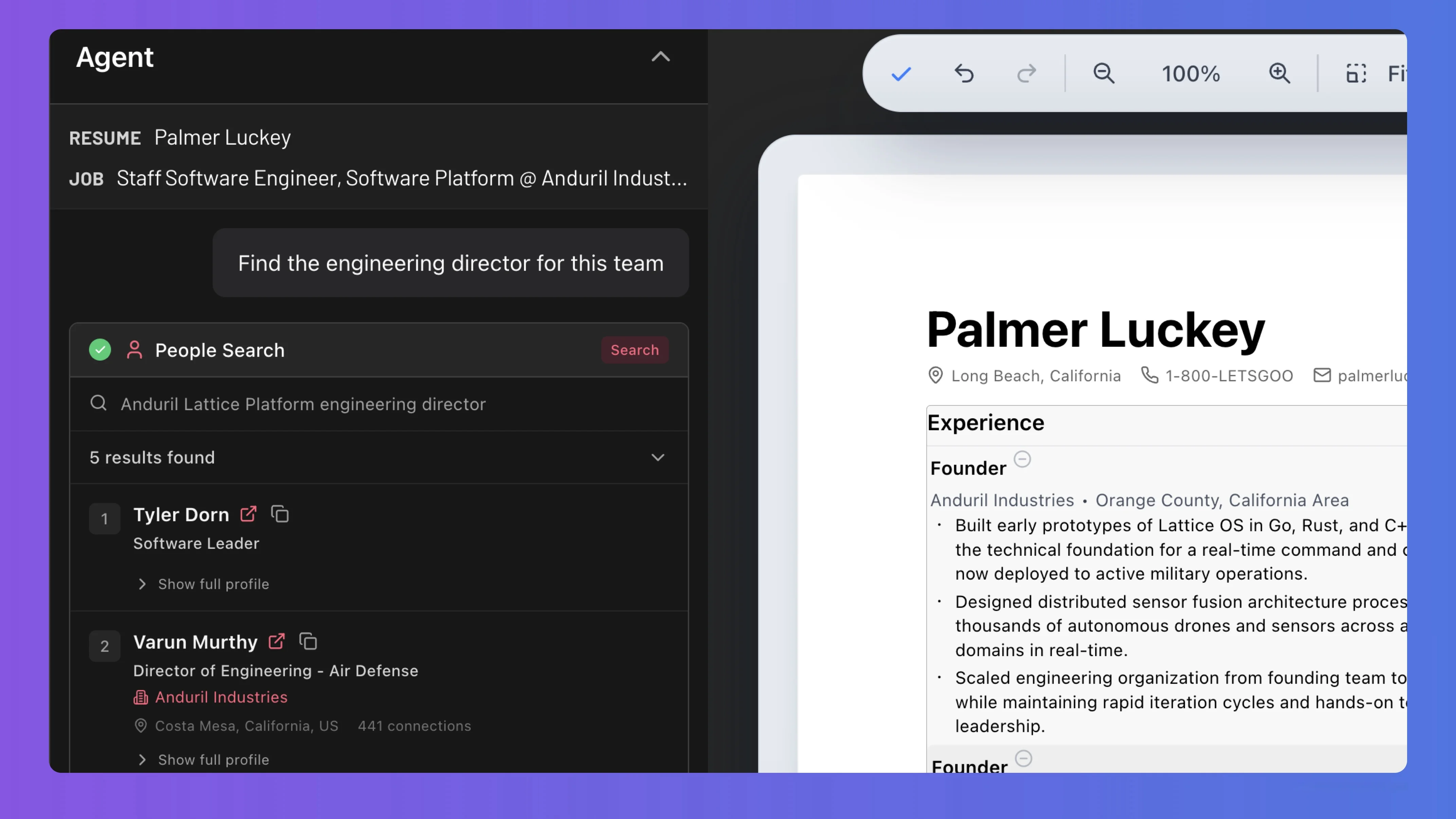
This is who might be interviewing you. This is who you might be reporting to. Knowing their background helps you speak their language, ask better questions, and figure out if you'd actually want to work with them.
Company Research: Know What They Actually Care About
The second tool: Company Research. What's the engineering culture like? What's their tech stack? What do their engineers write about? How do they ship?
You get back content from engineering blogs, company pages, press, interviews. The stuff that tells you what they actually value. Not the corporate "we're a family" fluff from the careers page.
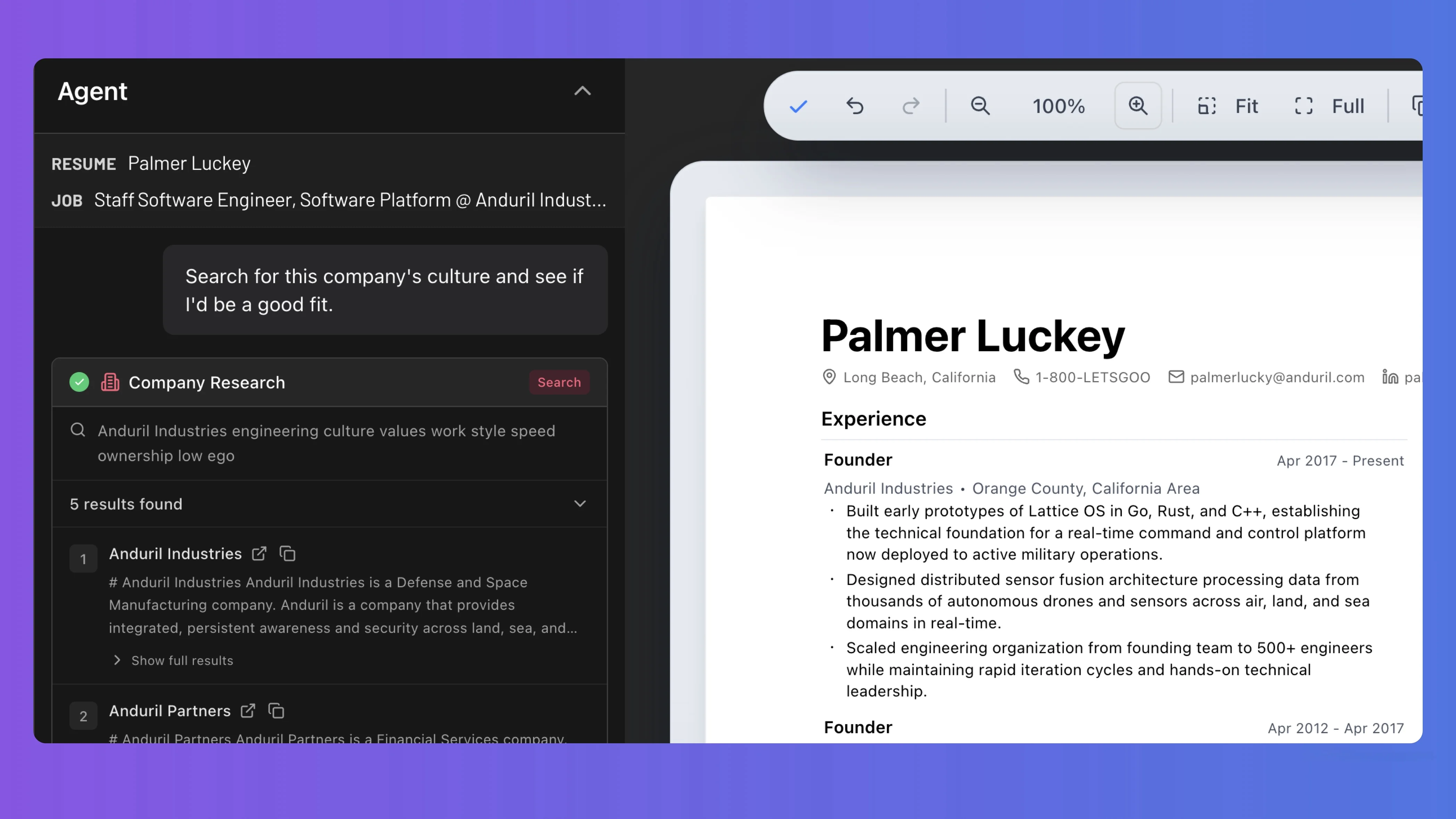
Now you can speak their language in the interview. Mention something from their engineering blog. Reference their tech stack choices. Ask about a recent product launch. You're not just another candidate. You're someone who did their homework.
Web Search: The Full Picture
The third tool: general Web Search. For everything else. Recent funding news. Leadership changes. Product launches. The stuff that gives you context.
Did they just do layoffs? Good to know before you apply. Did they just raise a massive round? Might mean growth opportunities. Is the CEO all over Twitter being controversial? Could be a red flag. This is the context that helps you make an informed decision.
Context-Aware Research
Here's the thing: your job posting is already in context. Your resume is already in context. You don't need to repeat yourself. Just ask natural questions and the agent connects the dots.
No copy-pasting company names. No re-explaining which job you're looking at. The context is there. You just ask what you want to know.
Results show up inline. Copy profiles as markdown for your notes. Research flows right into your resume editing. It's one conversation, not five browser tabs.
This Is About You, Not Them
Let's be clear about what this isn't: it's not about gaming the system or tricking your way into a job. It's about showing up informed.
A job is a two-way street. They're evaluating you, but you should be evaluating them too. Is this team healthy? Is this manager someone you'd learn from? Is this company going somewhere? These are questions you deserve answers to before you commit.
If the research turns up red flags (high turnover, bad Glassdoor reviews, a manager who jumps ship every 18 months) you just saved yourself months of frustration. That's not a failed job search. That's a win.
And if the research looks good, you walk into that interview as the most prepared candidate they've seen. You ask smart questions. You reference things they've shipped. You already know who's who. That confidence shows.
Try It
Next time you're working on a resume for a specific job, don't just tailor the bullets. Research the team. Research the company. Know what you're getting into.
You're not just looking for a job. You're looking for the right job. The research tools are there to help you find it.
Research Before You Apply
Find who's on the team. Learn what the culture's actually like. Show up informed.
Related Articles
Rezzy Doesn't Write Your Resume. It Makes You Write Better.
Most AI resume tools polish your bullets into corporate mush. Rezzy does the opposite: it grades your work, asks what you actually did, and helps you say it clearly.
How We Built Rezzy: An AI Agent That Actually Edits Your Resume
A technical look at our AI agent: 30+ tools, human-in-the-loop approval, and why most AI resume tools get it wrong.