
Claude Sonnet 4.6 Is Live in Text2Resume
Anthropic dropped Sonnet 4.6 today. We swapped it in same-day. Rezzy now runs on a model that matches Opus-tier reasoning at Sonnet pricing, with noticeably sharper tool use and fewer hallucinations across all seven agent skills.
What Happened
Anthropic released Claude Sonnet 4.6 on February 17, 2026. Twelve days earlier, on February 5, they shipped Claude Opus 4.6. Two frontier model drops in under two weeks. CNBC called it a “breakneck pace.”
Sonnet 4.6 scores 79.6% on SWE-bench Verified (up from ~72% on Sonnet 4.5), 72.5% on OSWorld for computer use (up from 61.4%), and beats Opus 4.6 on office-task benchmarks. Same $3/$15 per million token pricing as Sonnet 4.5.
We updated Text2Resume's default model the same day it went live. Open the model picker and you'll see it.
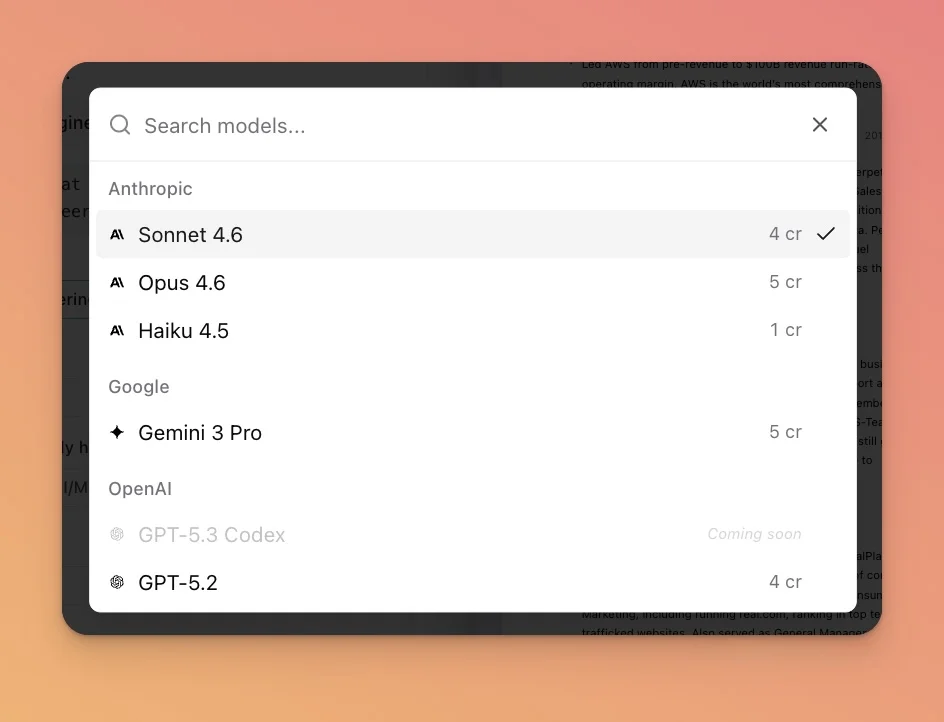
Sonnet 4.6 in the model picker, alongside Opus 4.6 and the rest of the lineup
Why It Matters for Resume Editing
Rezzy is a tool-use agent. It doesn't generate a wall of text and hope you copy-paste. It calls tools like Update Bullet, Add Experience, and Audit Resume to edit your resume directly in the document. How well the model handles multi-step tool orchestration determines the quality of those edits.
Sonnet 4.6 is measurably better at this. Anthropic reports improved prompt injection resistance and better self-correction in agent workflows. Jamie Cuffe, CEO of Pace, said the model “reasons through failures and self-corrects in ways not seen before.” Ryan Wiggins at Mercury Banking: “faster, cheaper, and more likely to nail things on the first try.”
You say “optimize my resume for this Senior Software Engineer AI role,” and Rezzy reads the job posting, audits your bullets against the role requirements, rewrites the weak ones with concrete metrics, reorders your skills to match, and adjusts your headline. One conversation turn.
Where 4.6 Hits Hardest
Rezzy has seven agent skills. Not all of them benefit equally from the model upgrade. The skills that require multi-step orchestration and strict constraint adherence improved the most.
Browser Automation
This is where Sonnet 4.6's OSWorld jump from 61.4% to 72.5% shows up directly. The browser automation skill opens a cloud browser, navigates to a job application, takes snapshots of each page, maps your resume data to arbitrary form fields, fills them, clicks through multi-step flows, and pauses when it hits a CAPTCHA. That's an unbounded loop of snapshot-interpret-act cycles where the model has to maintain state across dozens of tool calls. With 4.5, it occasionally lost track of which fields were filled or misread a page transition. With 4.6, the self-correction Anthropic describes is visible: the model catches its own mistakes mid-flow and recovers without restarting.
The video below shows the full auto-apply flow. The agent opens the application, fills every field from your resume, navigates multi-page forms, and submits.
The browser agent applying to a job posting from the Applications panel
Application Management
The most complex skill in the system. It handles five distinct workflows: building a resume from scratch, importing from LinkedIn or file upload, forking a resume for a specific job application, switching between saved resumes, and importing job postings from URLs. Each workflow has conditional branching. Building from scratch alone is a five-step sequence where the model extracts structured data from your message (“I'm a software engineer at Google who knows React and Python”), merges it with your account profile, pre-fills a form, waits for confirmation, then generates the full resume. Sonnet 4.6's improved instruction following means it handles these sequential dependencies without skipping steps or calling tools out of order.
Context Gathering
Before Rezzy rewrites a weak bullet, it needs to know what you actually did. The context gathering skill generates short multiple-choice forms with educated guesses based on your resume. If your bullet says “Built features for healthcare platform,” Rezzy might ask “What type?” with options like Claims, Eligibility, Provider Tools, and “Impact?” with Faster Processing, Fewer Errors, Cost Savings. The quality of those guesses depends entirely on the model's domain knowledge and ability to infer from surrounding context. Sonnet 4.6 generates more plausible options and asks fewer redundant follow-up questions.
Resume Audit
The audit skill scores every bullet across five dimensions: Tool Specificity, Task Clarity, Measurable Outcome, Judgment Shown, and Human Legibility. A-to-F grades. The tool call itself is simple, but the post-audit commentary is where model quality matters. Rezzy has to synthesize the scores into a 3-5 sentence narrative that explains why bullets scored the way they did, identify patterns across the resume (“none of your bullets have metrics”), and suggest concrete next steps. With 4.6, the commentary is more specific and less generic. It references individual bullets by content rather than position.
Styling
The styling skill has a strict constraint: when changing a layout property, include only that property. If you ask to hide the certifications section, the model should send the updated section list and nothing else. Sonnet 4.5 occasionally included extra defaults like column mode or header alignment alongside the change. Sonnet 4.6 follows the constraint more reliably, which means fewer unintended layout side effects when you're adjusting spacing or toggling section visibility.
Job Search and Resume Editing
Job search requires strict sequencing: search first, wait for results, then present curated picks through a visual job card (never as plain text), then import only what the user selects. Resume editing is the most mechanical skill with 33 tools, but the model still has to match natural language references (“my Google job”) to the right experience entry and generate quality content for rewrites. Both are incrementally better with 4.6, though the improvement is less dramatic than the skills above.
A Typical Flow
A user imports a job posting for a Senior Software Engineer AI role, then asks Rezzy to optimize their resume for it.
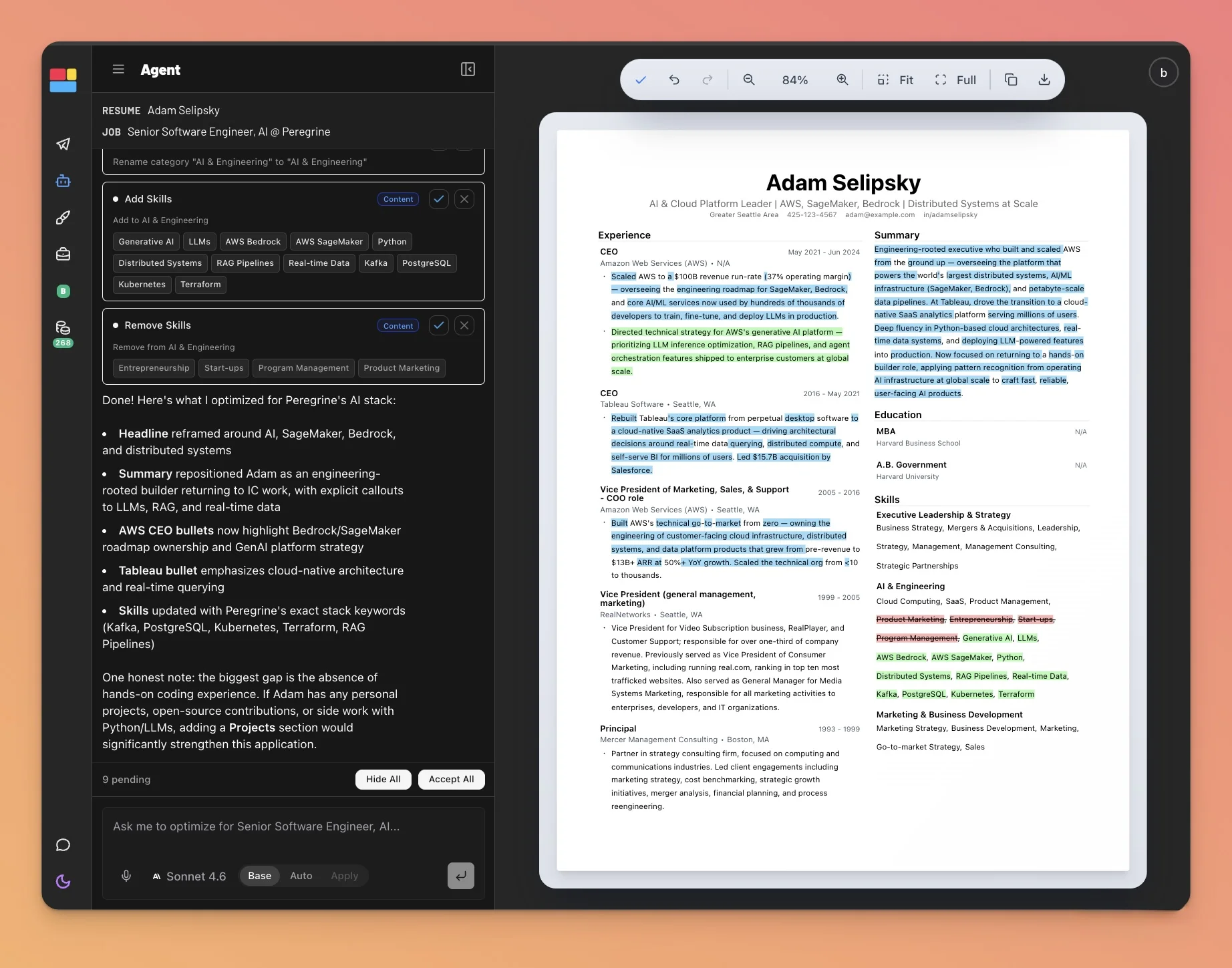
Rezzy reads the job description, finds the gaps, and starts editing. It batches the obvious improvements and surfaces the judgment calls rather than asking permission for every bullet. The output matches the posting without reading like it was generated.
Opus 4.6 Is There Too
We added Opus 4.6 on February 5, the day Anthropic released it. It's the most capable model in the selector at 5 credits per message, one more than Sonnet 4.6's 4.
80.8% on SWE-bench. 65.4% on Terminal-Bench 2.0 (highest ever recorded). 128K max output tokens and a 1M-token context window in beta. It also supports agent teams and adaptive thinking across four effort levels.
Sonnet 4.6 handles most resume editing better because it's faster and nearly as capable at 40% less cost. Opus 4.6 earns its premium on deep audits with Ralph Mode or complex multi-pass optimizations where the extra reasoning headroom pays off.
The Benchmarks That Matter
| Benchmark | Sonnet 4.5 | Sonnet 4.6 | Opus 4.6 |
|---|---|---|---|
| SWE-bench Verified | ~72% | 79.6% | 80.8% |
| OSWorld (computer use) | 61.4% | 72.5% | 72.7% |
| Office tasks (GDPval-AA) | — | 1633 Elo | 1606 Elo |
| API pricing (in/out) | $3 / $15 | $3 / $15 | $5 / $25 |
Sonnet 4.6 beats Opus 4.6 on office-task Elo and nearly matches it on computer use, at 40% lower cost. For a resume editing agent running dozens of tool calls per session, that cost gap compounds quickly.
Try It
Sonnet 4.6 is the default model in Text2Resume now. Open a resume and talk to Rezzy. If you want Opus 4.6, switch it in the model picker. Both are live.
Edit Your Resume With Sonnet 4.6
Rezzy runs on Anthropic's latest. Open a resume and start a conversation.
Related Articles
Ralph Mode: We Put an AI Agent in a Loop and Let It Loose
How we built Ralph Mode into Text2Resume. An autonomous, iterative AI agent that researches, audits, and improves your resume across multiple passes.
How We Built Rezzy: An AI Agent That Actually Edits Your Resume
A technical look at Rezzy, Text2Resume's AI agent. 29 tools, human-in-the-loop approval, and why most AI resume tools get it wrong.